Aerospace Carbon Fiber Parts Manufacturer
TechCarbonWorks is an established Aerospace Carbon Fiber Parts Manufacturer with deep experience producing flight-structure and interior composite components for customers in the United States, Europe, and Australia. Since our founding in Dongguan, China in 2005, we have invested continuously in the disciplines that aerospace programs demand: controlled processes, complete material traceability, and documentation that survives an audit years after delivery. Aerospace is not a market where “close enough” is acceptable. A bracket that looks correct but lacks a cure record is a liability, and a panel that cannot be traced to its resin lot fails source inspection. This page describes how we build aerospace-grade carbon fiber parts and the quality system that surrounds them.
Autoclave-Cured Structural Parts
The defining process for primary and secondary aircraft structure is autoclave curing. Applying both heat and consolidated pressure drives void content down and fiber volume up, producing laminates with the predictable mechanical properties that stress reports assume. As an Aerospace Carbon Fiber Parts Manufacturer we run qualified cure cycles with recorded temperature and pressure profiles, and we retain those records as part of the permanent file. Components such as spars, ribs, brackets, and fairings are laid up under clean conditions, debulked between ply groups to prevent wrinkling, and cured against precision tooling. The result is a structure that meets the allowables used in airframe analysis rather than a generic off-the-shelf panel.
Material Traceability and Certification
Traceability is the backbone of aerospace compliance. Every roll of prepreg, every batch of resin, and every core material carries a certificate that we capture at goods-in and link to the specific job. Our system records the laminate book, the operator, the autoclave cycle, and the inspection outcome against the serial or lot number. If a customer asks, three years later, which fiber lot went into a particular bracket, we can answer precisely. This chain of custody is what lets procurement and quality teams accept our parts into a certified airframe without re-deriving the material history themselves.
| Document | Purpose | When produced |
|---|---|---|
| Material cert (MTC) | Confirms resin/fiber spec compliance | Goods receipt |
| Layup book | Records ply schedule and orientation | During layup |
| Autoclave cycle log | Proof of qualified cure | During cure |
| CMM / inspection report | Dimensional conformance evidence | Post-machining |
| Certificate of conformance | Lot acceptance statement | At shipment |
FOD Control in the Production Environment
Foreign object damage (FOD) is a persistent risk in composite shops because trimmings, fasteners, and tooling fragments can become embedded or retained in structure. We operate FOD-controlled areas with designated flooring, tool accountability boards, and staged cleanliness checks. Personnel wear lint-free garments and covered footwear, and bonding operations use counted, signed-out tooling so nothing is left inside a closed assembly. Final inspection includes visual and, where appropriate, borescope verification of cavities. An Aerospace Carbon Fiber Parts Manufacturer that cannot demonstrate FOD discipline should not be on a qualified supplier list.
Dimensional Inspection and CMM Reports
Aerospace geometries rarely forgive sloppy tolerances. Mating faces, fastener patterns, and aerodynamic contours must land within the drawing limits or the part will not assemble or will disturb airflow. We verify critical features with coordinate measuring machines and supply dimensional reports tied to the nominated datum reference frame. For compound contours we use dedicated fixtures and laser scanning to confirm the as-built surface against the CAD model. First-article measurement precedes any production release, so tooling corrections happen before a single production unit is at risk. Our CNC machining of carbon fiber parts cell handles the precision trimming and insert installation that aerospace assemblies require.
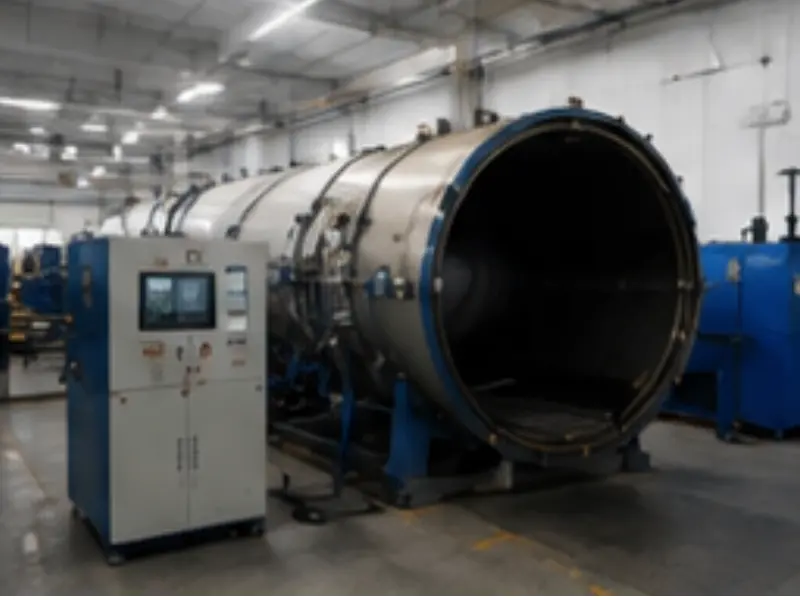
Autoclave curing of aerospace-grade carbon fiber laminates under controlled temperature and pressure cycles.
Interior Panels and Cabin Components
Not every aerospace component is a load path. Cabin interior panels, stowage bins, and decorative skins demand a different balance: low weight, excellent surface finish, and often fire-smoke-toxicity (FST) compliant materials. We produce these panels as sandwich constructions with lightweight cores and thin composite skins, finished to a class-A surface where visible. Because interiors are inspected by cabin crew and passengers, finish consistency matters as much as mass. Our custom carbon fiber parts manufacturer program supports both structural and decorative interior work.
Satellite and Space Applications
The space environment imposes its own rules: extreme thermal cycling, vacuum, and strict outgassing limits. We manufacture secondary and non-flight-critical space structures — brackets, support frames, equipment panels — using materials selected for low outgassing and stable dimensional behavior. These parts are built under the same traceability and cleanliness discipline as our aircraft work, with additional attention to contamination control. While we are not a flight-certification body, we supply the evidence package that lets your integration team qualify the component into the spacecraft bill of materials.
Documentation Packages for Audit Readiness
Aerospace buyers do not just buy a part; they buy the proof that the part is what it claims to be. A standard documentation package from TechCarbonWorks includes material certificates, autoclave cure logs, layup records, inspection and CMM reports, first-article records, and a certificate of conformance. We tailor the dossier to your quality manual and export it alongside the shipment. This is the difference between a component that clears source inspection on the first try and one that triggers a non-conformance report. As an Aerospace Carbon Fiber Parts Manufacturer we treat the paperwork as a deliverable, not an afterthought.
Non-Destructive Testing and Void Control
Void content is the quiet killer of composite strength. A laminate that looks flawless on the surface can hide delaminations or porosity that cut shear performance. As part of our aerospace discipline we apply non-destructive evaluation appropriate to the part class: tap testing for skin-to-core debond, ultrasonic scanning for internal voids, and visual densitometry checks on sample coupons from the same cure. When a program specifies a maximum allowable void fraction, we prove conformance with measured data rather than assumption. This testing sits alongside the CMM work described earlier and feeds the documentation package so the customer receives evidence of both geometry and internal quality.
Weight Savings Versus Traditional Metals
The business case for an Aerospace Carbon Fiber Parts Manufacturer usually starts with mass. Replacing an aluminum bracket or panel with a qualified carbon laminate can cut structural weight by 30 to 50 percent, and in aircraft that saving compounds into fuel burn, payload, or range improvements. We help programs quantify that trade early, modeling the part in both metals and composite to show where carbon pays for itself and where a metal insert remains the smarter choice at a bonded interface. The objective is never carbon everywhere; it is the right material at each location, documented and traceable.
Materials and Resin Systems
We work with aerospace-grade epoxy prepregs, toughened resin systems for damage-tolerant zones, and a range of core materials including aluminum honeycomb and lightweight foam. Where programs require it, we qualify alternative fiber architectures and maintain separate, controlled storage for aerospace-rated stock so it never commingles with commercial material. Our broader carbon fiber manufacturing services describe the resin families available across programs.
Process Flow From Drawing to Delivery
- Design review and laminate definition with your engineering team.
- Tooling fabrication, often via our carbon fiber mold making service.
- Controlled layup with debulk and FOD checks.
- Autoclave cure with recorded cycle.
- CNC trim, insert bonding, and CMM inspection.
- Documentation assembly and worldwide shipping.
Industries Served
Beyond commercial and defense aviation, our aerospace work supports unmanned aircraft structures, satellite subsystems, and research institutions building experimental airframes. We also collaborate with teams needing carbon fiber prototyping services to prove a geometry before committing to autoclave tooling. The same quality system scales from a single prototype bracket to a recurring production lot.
Quality System and Worldwide Shipping
TechCarbonWorks has maintained an ISO 9001 quality management system as the foundation of its operations, and our aerospace work layers program-specific controls on top of that baseline. We ship worldwide with established logistics to the United States, Europe, and Australia, and we support both one-off structures and steady production. Export documentation, including certificates and inspection records, travels with every order.
Frequently Asked Questions
The FAQ schema above addresses traceability, autoclave capability, FOD control, CMM verification, space applications, and documentation packages. These are the questions aerospace sourcing managers ask first, and our answers reflect the controls we actually operate on the shop floor.
Request a Quote for Aerospace Components
If you are qualifying a new supplier or resourcing an existing aerospace program, we welcome the conversation. As an Aerospace Carbon Fiber Parts Manufacturer founded in 2005, we combine autoclave capability with the traceability and documentation discipline that airframe programs require. Contact our engineering desk at [email protected] to share drawings, discuss material certification, or arrange a first-article plan. You can also review our main TechCarbonWorks site and our carbon fiber manufacturing blog for more on aerospace composite process control.