About Our Carbon Fiber Manufacturing Services
TechCarbonWorks delivers integrated carbon fiber manufacturing services from our Dongguan, China facility, which we founded in 2005. We exist to solve a specific problem for engineering and sourcing teams in the United States, Europe and Australia: finding a supplier that can take a carbon fiber program from raw material to finished, inspected part without fragmenting the work across a chain of subcontractors. Our answer is vertical integration. We operate our own mold shop, prepreg layup clean room, autoclaves, CNC machining center and metrology room, so the carbon fiber manufacturing services we quote are the carbon fiber manufacturing services we actually perform.
For an engineer, the value of consolidated carbon fiber manufacturing services is risk reduction. Every time a part changes hands between vendors, there is a chance for miscommunication about datum, cure cycle or tolerance. By keeping layup, cure, machining and inspection in one plant, we hold a single chain of accountability. When a dimension is challenged, we can trace it to the mold, the layup batch and the machine program without blaming a third party.
Capability Overview
Our carbon fiber manufacturing services are organized into clearly defined stages, each with its own quality gate:
- Design for manufacturability review — we analyze your CAD for draft, radii, inserts and datum strategy before tooling.
- Tooling and mold making — CNC-machined aluminum or steel tools, composite tools and soft tooling for prototypes.
- Laminating — prepreg and hand layup of Toray T300, T700, T800, twill, plain, forged and hybrid materials.
- Curing — vacuum bag oven cure and autoclave cure with documented, logged cycles.
- Machining — 3-axis and 5-axis trimming, drilling and pocketing of cured laminates.
- Finishing and assembly — bonding, inserts, painting, clear coat, printing and sub-assembly.
- Inspection — incoming, in-process and final CMM verification with full reporting.
This staged structure lets us scale a program smoothly from a single prototype to recurring production batches while preserving the process discipline that high-performance composites demand.
Manufacturing Processes We Operate
The heart of our carbon fiber manufacturing services is process mastery across the methods that matter for real programs.
Prepreg Molding
Prepreg molding is our default for structural and appearance-critical work. Fiber pre-impregnated with a precisely controlled resin content is cut, debulked and laid into the mold, then cured under heat and pressure. Because resin content is fixed at the prepreg stage, we achieve repeatable fiber volume fractions and low voids part after part.
Hand Layup
Hand layup remains essential for large panels, complex contours and low-volume runs. In our clean room, technicians place each ply according to the laminate schedule, integrating cores, local reinforcements and inserts. The flexibility of hand layup makes it ideal for custom geometries that would be costly to tool conventionally.
Vacuum Bagging
Vacuum bagging is applied to nearly every laminate we build. By enclosing the part in a sealed bag and drawing vacuum, we remove trapped air and compact the stack, cutting void content well below ambient-pressure methods. For many industrial and UAV components, vacuum bagging plus oven cure delivers excellent performance at an attractive cost.
Autoclave Curing
When the application is demanding, we cure in an autoclave at elevated pressure, typically 6 to 7 bar, combined with vacuum on the laminate. This consolidates the part, suppresses voids below one percent and unlocks the full mechanical properties specified for aerospace and motorsport laminates. Every cycle is logged for traceability.
CNC Machining
Cured carbon fiber is hard, abrasive and prone to delamination if mishandled, so we run dedicated 3-axis and 5-axis centers with rigid fixturing, diamond-coated tooling and dust extraction. Critical features that cannot be molded — precision holes, pockets and contoured edges — are machined to plus or minus 0.05 mm and referenced to molded datum faces.
Mold Making
Tooling quality sets the ceiling on part quality. We machine molds from aluminum for production and from composite or soft materials for prototypes, then validate each mold with a first-article before release. Good mold design accounts for cure shrinkage, draft and parting line, so finished components meet print without rework.
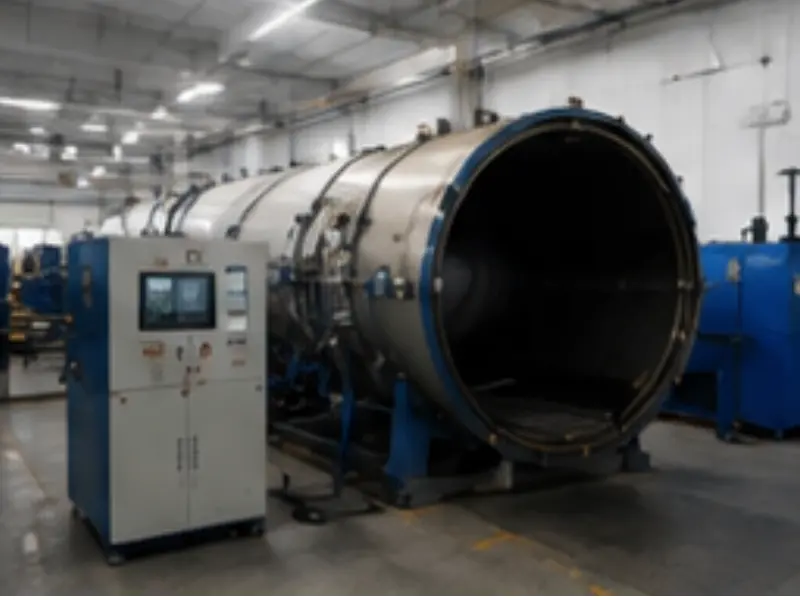
Autoclave curing consolidates prepreg laminates under heat and pressure to achieve low void content and high mechanical properties.
Specification and Tolerances
A core part of our carbon fiber manufacturing services is being explicit about what we can hold. The table below summarizes typical capabilities; final numbers are confirmed against your print during quotation.
| Capability | Typical performance |
|---|---|
| Molded nominal geometry | ±0.15 mm |
| CNC-machined critical features | ±0.05 mm |
| Hole position (referenced to datum) | ±0.05 mm |
| Flatness on bonded assemblies | ±0.1 mm |
| Surface finish (gloss clear) | < 0.4 micron Ra |
| Maximum autoclave panel size | 1500 x 1000 mm |
| Fiber volume fraction (prepreg) | 58-62 percent |
We document these parameters in a control plan attached to every production release, and we verify the ones that matter to your function with CMM measurement. Where a feature is safety- or fit-critical, we machine rather than mold it and record the tool path in the build file.
Material Options
Our carbon fiber manufacturing services support a wide material set so we can match the right fiber to the job:
| Material | Strength tier | Common application |
|---|---|---|
| Toray T300 prepreg | Standard | Brackets, enclosures |
| Toray T700 prepreg | High | Structural arms, frames |
| Toray T800 prepreg | Ultra-high | Lightweight aerospace parts |
| 3K twill weave | Cosmetic | Visible shells, covers |
| 3K plain weave | Stable | Flat panels |
| Forged carbon | Isotropic | Organic-shaped parts |
| Carbon-kevlar hybrid | Tough | Impact-exposed zones |
All prepreg is stored at -18C and lot-tracked. We can qualify custom resin systems, flame-retardant chemistries or recycled-content prepregs through a documented trial before committing to production.
Industries We Support
Our carbon fiber manufacturing services span multiple sectors, each with distinct documentation needs:
- UAV and drones — airframes and payload mounts where every gram counts.
- Aerospace — secondary structures and interior panels to laminate schedules.
- Motorsport — aero and intake parts where stiffness-to-weight wins races.
- Medical — stable imaging frames and ergonomic housings.
- Industrial robotics — lightweight arms improving payload and speed.
- Sporting and consumer — premium shells where appearance is part of the spec.
Because we serve regulated and performance-critical programs worldwide, our quality records are built to satisfy Western OEM expectations without constant on-site auditing.
Quality and Certifications
We are ISO 9001 certified, and quality gates run through every stage of our carbon fiber manufacturing services. Incoming material is checked against certificates, in-process audits confirm ply count and orientation, and final CMM inspection verifies critical dimensions. Each shipment carries a material certificate, laminate build record and inspection report, giving full lot traceability from frozen prepreg to packaged part.
For sourcing managers, this means predictability: when a print calls for a tolerance, our report shows we measured it; when a schedule calls for a specific ply sequence, our build record proves it. That discipline is why teams across the US, Europe and Australia rely on us for demanding programs.
Choosing the Right Service Mix
Not every program needs autoclave cure or 5-axis machining. As part of our carbon fiber manufacturing services we help customers select the leanest process that still meets the requirement. A large non-critical cover may be best as hand layup with vacuum bag curing; a tight-tolerance bracket may be molded then CNC-trimmed; a flat plate with net features may simply be machined from stock laminate. We present these options transparently at quotation so you can balance cost, lead time and performance.
From Inquiry to Production
Our carbon fiber manufacturing services follow a predictable path that keeps engineering teams informed at every step. It begins with a design for manufacturability review, where we flag draft, radii and datum issues before tooling money is spent. Next we build and validate the mold with a first-article, then run a prototype batch so you can confirm fit and function. Once the tool is released, we ramp into production with an agreed inspection plan and milestone schedule. Throughout, we communicate cure cycles, material lots and measurement results so your sourcing team always knows the status of the build.
Process Selection Decision Guide
Choosing the right forming route is the single most consequential decision in any carbon fiber program, because it sets the cost floor, the achievable tolerance and the inspection burden for every part thereafter. As part of our carbon fiber manufacturing services we give every new program a short decision guide so the customer can see why a given method was recommended rather than receiving a quote built on an assumption.
The three primary laminating routes we operate are prepreg molding, wet hand layup and resin infusion. They are not interchangeable, and the right answer depends on quantity, performance class and surface expectation.
Prepreg vs Wet Layup vs Infusion
Prepreg molding uses fiber pre-impregnated by the supplier at a fixed resin content. It gives the tightest fiber volume control, the lowest voids and the most predictable mechanicals, which is why we default to it for structural and aerospace-class work. The trade-off is material cost and cold-chain handling, but for production that discipline pays back in rejection-free runs.
Wet layup, sometimes called wet hand layup, applies liquid resin by brush or roller as the dry fabric is placed. It is the most economical route for large panels and very low volumes, and it tolerates tooling that would be expensive to build for prepreg. The cost is lower process control: resin content varies with the technician and the ambient temperature, so mechanical properties have a wider band.
Resin infusion, usually vacuum-assisted resin transfer molding, draws resin through a dry fiber stack under vacuum. It suits large, moderately complex parts and delivers good fiber wet-out with low voids and very low styrene emission. Infusion tooling can be less costly than autoclave-rated prepreg tooling, but cycle time is longer and the laminate is harder to make net near aerospace tolerance.
We summarize the choice in the following comparison so our customers can sanity-check the recommendation:
| Factor | Prepreg | Wet layup | Infusion |
|---|---|---|---|
| Fiber volume control | Excellent | Moderate | Good |
| Void content | Lowest | Higher | Low |
| Tooling cost | Higher | Lowest | Low to moderate |
| Best volume | Prototype to high | Very low | Low to medium |
| Surface both sides | Yes | One good side | Yes |
| Cycle time | Short | Medium | Long |
Our carbon fiber manufacturing services team uses this table together with your drawing to recommend the leanest route that still meets the performance requirement, and we will state plainly when a cheaper method would compromise your function. For early-stage validation we often point customers to our carbon fiber prototyping services before committing to a production route.
Autoclave vs Oven Cure
Within any laminating route, the cure step decides consolidation and void content. The two industrial options are oven cure under vacuum bag and autoclave cure under added pressure.
Oven curing places the vacuum-bagged part in a heated chamber and pulls vacuum on the laminate to compact it. It is robust, lower cost and adequate for most industrial, UAV and consumer parts where void content below about two to three percent is acceptable. Every oven cycle is logged for temperature uniformity and dwell time.
Autoclave curing adds 6 to 7 bar of inert-gas pressure on top of laminate vacuum. The pressure drives resin into micro-gaps, suppresses voids below one percent and raises the effective fiber volume fraction. For aerospace secondary structures, motorsport load paths and any part where compression strength is specified, autoclave cure is the correct choice. The penalty is capital and cycle cost, plus tooling that must withstand the pressure.
We help customers decide by asking a simple question: is the part loaded in a way where a void becomes a crack initiator? If yes, autoclave; if no, oven. Our carbon fiber manufacturing services quote both paths where the drawing allows it, so the cost difference is visible before commitment. More detail on cure selection is published on our main carbon fiber manufacturing services page.
Quality Documentation and Traceability
Documentation is not paperwork to us; it is the proof that the part you receive is the part you approved. Every order under our carbon fiber manufacturing services leaves with a coherent record set:
- Material certificate for each prepreg lot, with fiber type, resin system and shelf status.
- Laminate build record showing ply count, orientation, sequence and any local reinforcement.
- Cure cycle log with temperature and pressure trace for the specific part or batch.
- First-article or CMM inspection report covering the critical dimensions on your drawing.
- Coating and finishing record where paint, clear coat or printing is specified.
For Western OEM programs we structure these records to satisfy incoming inspection without a site visit, and we retain them for an agreed period so a future audit can reconstruct any shipment. Lot traceability runs from frozen prepreg through packaged part, which means a field question can be answered with data rather than recollection.
Tooling Strategy for Production Programs
Tooling is the largest single investment in most programs, so our carbon fiber manufacturing services treat tool life and mold strategy as a design decision, not an afterthought. We classify tooling into three tiers:
- Soft tooling, typically silicone or composite, for prototypes and very low volumes where speed matters more than cycle count.
- Composite or epoxy tooling for medium runs where the part count does not justify metal but the geometry must be stable.
- CNC-machined aluminum or steel production molds for recurring volume, designed with draft, shut-off and datum features that survive thousands of cycles.
We decide the tier with you based on forecast volume, surface requirement and the number of program revisions still expected. A mold built one tier too high wastes capital; built one tier too low, it fails mid-program and forces a costly re-tool. Our engineers will show the crossover point in the quotation so the choice is transparent. Tool design itself is covered in depth by our carbon fiber mold making service.
Production Ramp Planning
A smooth ramp protects both your launch schedule and our quality system. Our carbon fiber manufacturing services approach ramp in four phases. Phase one is tool validation with a first-article part and a dimensional report. Phase two is a low-rate initial production batch, typically ten to fifty parts, used to prove the process window and train the cell. Phase three lifts rate while we watch critical dimensions with statistical process control. Phase four is steady production with a confirmed inspection plan and a replenishment schedule.
Throughout the ramp we communicate cure cycles, material lots and measurement trends so your sourcing team sees a problem before it becomes a shipment. This staged discipline is why programs that start as a prototype in our plant can scale to recurring volume without re-qualification drama.
Related Pages
Our carbon fiber manufacturing services connect closely with our other capabilities. Review the custom carbon fiber parts manufacturer page for build-to-print production, or the dedicated CNC machining of carbon fiber parts and carbon fiber prototyping services pages. Tooling is covered by our carbon fiber mold making service, and industry-specific programs are detailed for UAV, aerospace, motorsport and robotics customers.
Start a Conversation
If you are scoping a program and want carbon fiber manufacturing services that are vertically integrated, transparent and export-ready, we are ready to help. Share your drawings, target volumes and performance targets, and we will return a clear quotation with a milestone schedule.
Reach our engineering team directly at [email protected], or explore our main site at TechCarbonWorks and our detailed carbon fiber manufacturing services page. Since 2005 we have helped companies in the US, Europe and Australia turn carbon fiber designs into reliable production parts, and we look forward to supporting your next project. For deeper process insight, our carbon fiber manufacturing blog publishes practical engineering guidance.