Robotics Carbon Fiber Parts Manufacturer
TechCarbonWorks is a dedicated Robotics Carbon Fiber Parts Manufacturer serving automation integrators, robot original equipment manufacturers, and research labs in the United States, Europe, and Australia. Since our founding in Dongguan, China in 2005, we have helped machine builders solve the problem that defines modern robotics: the moving mass of a robot is the enemy of speed and precision. Every kilogram a designer removes from an arm link lets the same motor move faster, settle sooner, and repeat more accurately. Carbon fiber is the most effective way to strip that mass without surrendering the stiffness the task demands. This page explains the robot structures we build, why lower moving mass shortens cycle times, and how we control stiffness, damping, and tolerance.
Robot Arms and Links
The articulated arm is the heart of any manipulator, and its links are the components where carbon fiber pays the largest dividend. A traditional aluminum link carries inertia that the joint motor must overcome on every acceleration and brake. We replace that link with a carbon laminate tuned so the bending and torsional stiffness match the load case at a fraction of the mass. As a Robotics Carbon Fiber Parts Manufacturer we design each link around its actual moment demand, placing unidirectional carbon along the bending axis and woven cloth where impact or handling abuse is likely. The outcome is an arm that reaches its target faster and stops on it.
Wrist and Forearm Structures
The wrist carries the end effector and suffers the highest dynamic load because it sits at the longest moment arm. We build wrists as compact, stiff assemblies with bonded bearing seats and cable routing channels molded in, reducing the peripheral mass that the elbow and shoulder must swing.
End-Effector Frames
Grippers, vacuum plates, and vision mounts benefit from a rigid yet light frame so the payload capacity is spent on the part, not the tool. We produce these frames with flat, machinable mounting faces and tight hole patterns for off-the-shelf gripper components.
Gantry Beams and Bridges
Gantry and Cartesian robots move a carriage along a long beam, so beam straightness and mass dominate performance. A carbon gantry beam is dramatically lighter than steel or aluminum extrusions, which lets smaller drives achieve higher traverse speeds. We control bow and twist during layup and verify flatness after cure so the carriage tracks true across the full stroke. For a Robotics Carbon Fiber Parts Manufacturer, long-beam dimensional stability is a core competency, because a beam that droops under its own weight ruins accuracy at the extremes of travel.
Composite workshop producing robot arm links, end-effector frames, and gantry beams under controlled process.
Lower Moving Mass Means Faster Cycle Times
The single most compelling reason to specify carbon in robotics is cycle time. Robot motion is a repeated accelerate-hold-decelerate cycle; the energy and time needed scale directly with the moved inertia. A lighter arm link means the same servo torque produces higher acceleration, so each move completes in less time. Across a million picks per year, even a few milliseconds saved per cycle becomes meaningful throughput, and the robot may need a smaller, cheaper actuator to achieve the same performance. Our custom carbon fiber parts manufacturer program quantifies this trade with the integrator during design review so the business case is explicit before tooling.
Stiffness and Vibration Damping for Precision
Speed is worthless if the arm cannot hold position. Compliance at the tool tip and residual vibration after a move both create positioning error that shows up as scrap or missed insertions. We address precision through two levers. First, laminate stiffness: high-modulus fibers and the right ply schedule keep deflection within the robot’s repeatability budget even under rated load. Second, damping: woven and sandwich constructions dissipate energy faster than pure unidirectional laminates, so the arm settles quickly instead of ringing. The table below maps structural choice to the robotics requirement it serves.
| Robotics requirement | Laminate approach | Result |
|---|---|---|
| Fast cycle time | Low-mass UD link | Higher acceleration |
| Tool-tip repeatability | High-modulus skin | Minimal deflection |
| Quick settle after move | Woven or damped layup | Less residual vibration |
| Long gantry straightness | Stiff core, twist control | True tracking |
| Durable gripper mount | Bonded metal insert | Stable interface |
Bonded Inserts and Metal Interfaces
A carbon structure must connect to motors, bearings, gears, and sensors, all of which are metal. We engineer these interfaces so clamp and torque loads spread into the composite rather than crushing it. Threaded inserts are bonded or potted into localized solid laminate, and we wrap unidirectional carbon around the joint to carry peel and shear. For rotating joints we specify steel or aluminum inserts because they survive far more assembly cycles than a composite boss. Getting the metal interface right is what separates a Robotics Carbon Fiber Parts Manufacturer from a shop that simply molds a shape; the interface is where the robot actually transfers force.
Tolerance Control
Precision robots live or die by dimensional control. We CNC-machine all critical bearing bores, mounting faces, and hole patterns after cure using our CNC machining of carbon fiber parts cell, then verify them on a coordinate measuring machine against the datum scheme. Long beams are checked for bow, twist, and flatness so a gantry tracks true. We lock laminate books and tooling at production release so a recurring batch stays within the original first-article envelope, which matters when a machine builder is fitting our links into a calibrated kinematic chain.
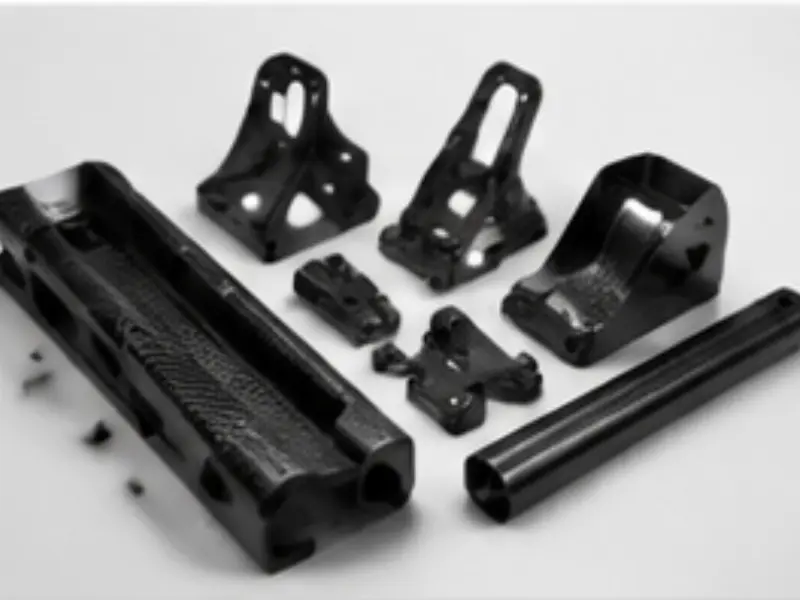
Finished robot links and end-effector frames prepared for inspection and worldwide shipment.
Thermal Stability in Precision Automation
Carbon fiber also helps where temperature changes would distort a metal link. Its coefficient of thermal expansion can be near zero when balanced against the resin, so a carbon arm holds geometry across a workshop that swings from cold startup to warm running. For metrology and semiconductor handling robots this dimensional stability is as valuable as the mass saving, because the robot does not drift as it warms up through the shift. We select low-CTE laminates and symmetric layups so the structure expands uniformly rather than bowing, protecting repeatability in climate-sensitive cells.
Materials and Process Options
We use standard and high-modulus carbon fabrics and prepreg, with toughened epoxy systems where impact resistance is needed at handling points. Vacuum-bag oven curing serves most links and frames, while compression molding suits higher-volume, repeatable geometries. Core materials such as lightweight foam and honeycomb reduce mass in large panels and beams. For machine builders planning series production, our carbon fiber mold making service hardens tooling that locks geometry across every future unit. The broader carbon fiber manufacturing services page lists available resin and fiber families.
Industries and Automation Applications
Our robotics work spans industrial pick-and-place arms, collaborative robot links, inspection gantries, semiconductor handling structures, and laboratory automation frames where cleanliness and low mass both matter. We also support research institutions building experimental manipulators through carbon fiber prototyping services, validating a link design before committing to production tooling. The same stiffness-and-mass discipline scales from a desktop arm to a factory gantry several meters long.
Quality, Certifications, and Worldwide Shipping
TechCarbonWorks runs an ISO 9001 quality management system, and robotics orders receive dimensional verification, symmetry checks on paired links, and finish inspection before packing. We ship worldwide with established routes to the United States, Europe, and Australia, supporting both prototype manipulators and recurring production supply. Inspection reports and material certificates travel with the shipment so your integration team can verify conformance on receipt.
Frequently Asked Questions
The FAQ schema above addresses robot part types, cycle-time benefits, stiffness and damping, metal insert integration, tolerance capability, and prototype-versus-production support. These are the questions automation engineers ask first when evaluating a composite link against a machined metal one.
Start a Robotics Component Program
If you are designing a new manipulator or resourcing an existing one, talk to our engineering desk. As a Robotics Carbon Fiber Parts Manufacturer founded in 2005, we help machine builders cut moving mass, tighten repeatability, and control tolerances across production. Reach us at [email protected] with your drawings, target masses, or a prototype request, and we will propose a laminate and lead time. You can also explore our main TechCarbonWorks site and our carbon fiber manufacturing blog for deeper reading on composite robot structure design.