UAV Carbon Fiber Components Manufacturer
TechCarbonWorks is a specialist UAV Carbon Fiber Components Manufacturer serving drone integrators, defense contractors, and survey equipment brands across the United States, Europe, and Australia. Since our founding in Dongguan, China in 2005, we have built a reputation for delivering flight-ready composite structures that resolve the single hardest problem in unmanned aviation: getting stiffness and durability without paying a weight penalty that shortens flight time. Whether you are building a heavy-lift multirotor, a long-endurance VTOL, or a compact inspection quadcopter, the airframe is where marginal weight savings compound into meaningful mission gains. This page explains how we engineer carbon fiber UAV parts, what we can produce, and how our manufacturing discipline keeps a hundred-unit fleet indistinguishable from the first article.
Why Carbon Fiber Dominates Modern UAV Structures
Unmanned aerial vehicles live and die by their mass budget. Every gram added to the structure must be lifted by the rotors for the entire mission, so airframe weight directly erodes payload capacity, range, and hover efficiency. Carbon fiber reinforced polymer (CFRP) offers a specific stiffness several times that of aluminum at roughly half the density, which makes it the default choice for performance-oriented airframes. As a dedicated UAV Carbon Fiber Components Manufacturer, we do not treat carbon as a cosmetic upgrade; we treat it as a load-bearing system where fiber direction, resin content, and cure quality decide whether a boom survives a hard landing or a motor mount holds torque through thousands of flight cycles.
The second reason composites win in UAVs is part consolidation. A machined aluminum frame needs brackets, fasteners, and gussets; a molded carbon shell can integrate mounting bosses, stiffening ribs, and cable channels into a single cured part. Fewer joints mean fewer failure points and a cleaner aerodynamic profile. Our custom carbon fiber parts manufacturer service is built around this consolidation philosophy.
Core Component Families We Produce
Airframes and Main Plates
The central fuselage plate or monocoque shell carries the highest combined loads: battery mass, flight controller, and reaction forces from every arm. We design these as quasi-isotropic laminates with local unidirectional reinforcement along the main bending axis, often using a foam or honeycomb core to resist buckling without adding weight.
Arms and Booms
Tubular and profiled arms translate motor thrust into the airframe while acting as the primary vibrational conductors. Our arms are typically roll-wrapped or compression-molded with a tuned fiber angle (often 45/90/0 schedules) that resists both bending and torsion. For VTOL and fixed-wing booms, longer aspect ratios demand careful aeroelastic analysis to avoid flutter.

Layup and trimming of carbon fiber drone arms, motor mounts, and payload plates in our composite workshop.
Motor Mounts
Motor mounts see concentrated torque and cyclic thrust. We CNC-machine mounting faces from the cured laminate or bond in aluminum inserts sized for the screw pattern, ensuring clamping load spreads into the composite rather than crushing it. As a UAV Carbon Fiber Components Manufacturer we pay special attention to the interface between rotating machinery and the lightweight structure.
Payload Plates and Gimbal Trays
Camera, LiDAR, and sensor payloads need a stable, low-vibration platform. We decouple the payload plate from the main structure using tuned damping layers and isolation standoffs, then verify the resulting modal behavior on prototype builds.
Weight-versus-Stiffness Tradeoffs
The central engineering conversation on any UAV program is the stiffness-to-weight ratio. Reduce ply count and the part gets lighter but more compliant; add plies and you restore stiffness at the cost of mass and, critically, a higher moment of inertia in rotating arms. Our approach is a laminate trade study:
| Design priority | Recommended layup | Effect on weight | Effect on stiffness | Typical use |
|---|---|---|---|---|
| Maximum endurance | Thin UD 0/90 skins, Nomex core | Lowest | Moderate | Long-range fixed wing |
| High-thrust multirotor | 45/90 schedule, solid laminate | Moderate | High torsional | Heavy-lift quad |
| Crash-tolerant inspection | Thick woven twill, rubber edge | Higher | High | Indoor/confined UAV |
| Gimbal stability | Damped sandwich, isolated plate | Moderate | Tuned damping | Survey/cinema drones |
We present this trade table to clients during design review so the sourcing manager understands exactly what each gram buys. The goal of a UAV Carbon Fiber Components Manufacturer is not the lightest possible part; it is the right part for the mission profile.
Layup Optimization for Flight Loads
Flight loads on a UAV are rarely symmetric. Forward acceleration, yaw from differential thrust, and landing impact each act along different axes. We model the dominant load paths and place unidirectional carbon tape where tension and compression are highest, reserving woven cloth for impact-prone zones and areas needing balanced properties. Fiber volume is held in a tight band (typically 55–62 percent) so resin-rich or resin-starved regions do not appear, both of which weaken the laminate. Our carbon fiber prototyping services let teams validate a layup on a small batch before committing to tooling.
Vibration Damping for Gimbal and Camera
Vibration is the enemy of usable aerial data. Even sub-millimeter boom resonance blurs imagery and corrupts point clouds. We address this on three levels: laminate selection (woven and sandwich constructions naturally damp more than pure unidirectional), local isolation at the payload interface, and symmetric construction so the structure does not develop unbalanced modes. For cinematic and mapping UAVs we often integrate a constrained-layer damping patch directly into the payload tray. These details are what separate a true UAV Carbon Fiber Components Manufacturer from a generic cut-and-glue shop.
EMI Transparency Considerations
Carbon fiber conducts electricity, which means a continuous carbon skin can shadow GPS antennas and attenuate 2.4 GHz and 5.8 GHz telemetry. We design around this by leaving RF-transparent windows in the layup, using non-conductive fillers around antenna mounts, and routing sensitive modules away from large continuous conductive areas. In some builds we apply a thin dielectric overlay on antenna-facing surfaces. Getting EMI behavior right is a quiet but essential part of UAV structural design.
Batch Consistency for Fleets
A single prototype is easy; a thousand interchangeable units is the real test. We lock laminate books, tooling, and cure parameters at production release so every part matches the first article. First-article inspection (FAI) plus periodic coordinate measuring machine (CMM) checks catch drift before it reaches your line. When a fleet operator swaps a damaged arm in the field, that replacement must be dimensionally identical to the original — that is the standard we hold as your UAV Carbon Fiber Components Manufacturer.
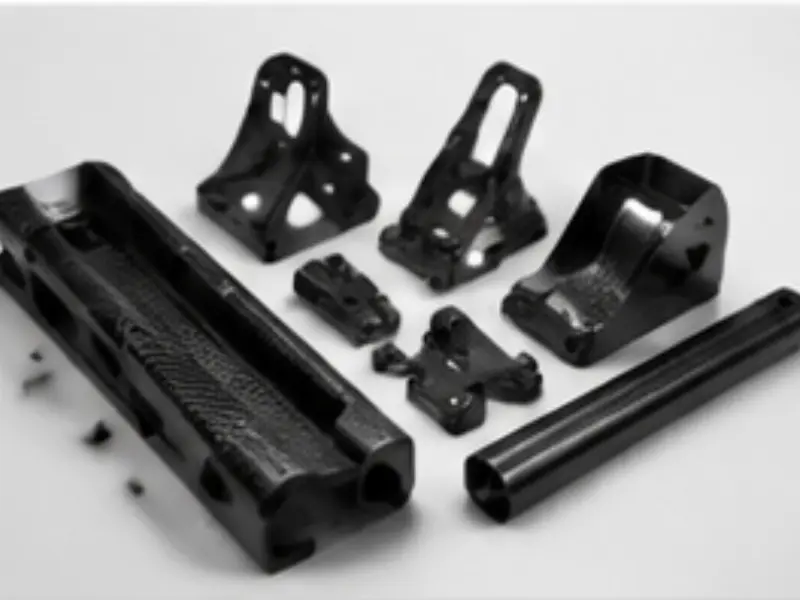
Finished custom carbon fiber UAV components awaiting dimensional and visual inspection prior to worldwide shipping.
Materials and Process Options
We work with standard modulus T300/T700 prepreg and fabric, and offer aerospace-grade intermediates where certification demands it. Processes include oven-cured vacuum bagging for cost-sensitive runs and compressed closed-mold methods for repeatable production. Our full carbon fiber manufacturing services overview covers available resin systems, including toughened epoxies for impact zones. For programs needing bonded metal interfaces, see our CNC machining of carbon fiber parts capability, which handles precision trimming and insert installation.
Industries and Applications
Beyond consumer and industrial drones, our UAV structures appear in agricultural sprayers, power-line inspection airframes, mapping and surveying platforms, and defense reconnaissance vehicles. The same design discipline scales from a 250 mm racing quad to a 2 meter wingspan survey aircraft. We also support mold making for carbon fiber so clients can later bring high-volume production in-house with tooling we have validated.
Quality, Certifications, and Worldwide Shipping
TechCarbonWorks has operated an ISO 9001 quality management system since the early stages of our growth, and our inspection records travel with every shipment. We ship worldwide, with established logistics routes to the United States, Europe, and Australia, and we support both low-volume prototype runs and steady recurring production. Detailed documentation, including material certs and dimensional reports, is available on request.
Frequently Asked Questions
The FAQ schema above covers the most common engineering and sourcing questions. Typical topics include airframe families, weight-versus-stiffness tradeoffs, EMI transparency, vibration control, fleet batch consistency, and lead times. Our engineering team is happy to walk your designers through a load case during a design review call.
Start Your UAV Component Program
If you are specifying a new airframe or resourcing an existing one, talk to our engineering desk. As an experienced UAV Carbon Fiber Components Manufacturer founded in 2005, we can take your drawings from prototype to validated production with the documentation your quality team requires. Reach us directly at [email protected] to request a quote, share STEP files, or schedule a laminate design review. You can also explore our main TechCarbonWorks site and our carbon fiber manufacturing blog for deeper technical articles on UAV composite design.